Why Casinos Ask for ID and How KYC Verification Works
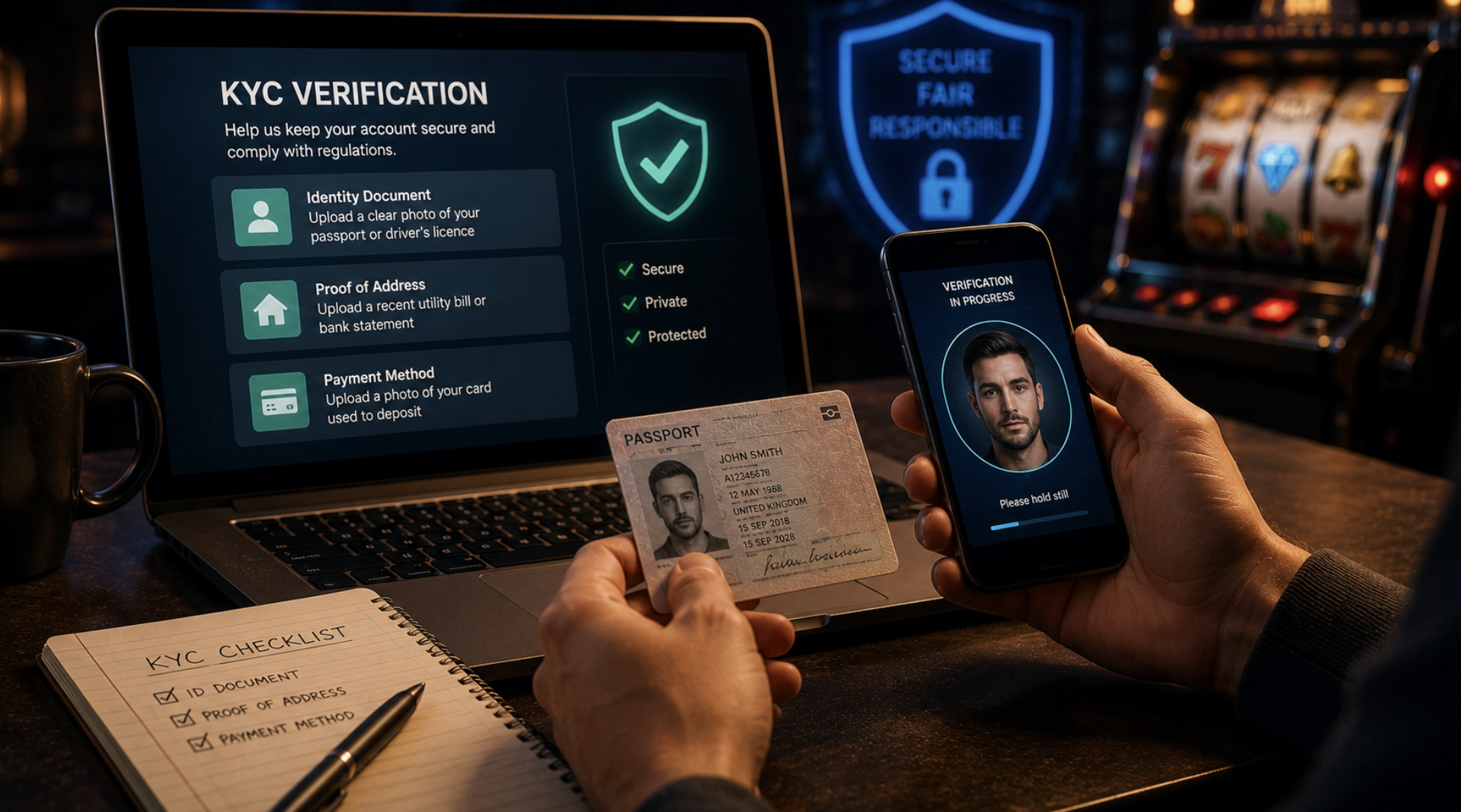
Sooner or later, nearly every online casino pauses a player and asks them to prove who they are. A photo of a passport or driver's licence, perhaps a recent utility bill, sometimes a picture of the card used to deposit. For a new player, and especially for one who hits this wall at the exact moment they try to withdraw a win, it can feel intrusive, slow and faintly suspicious. In reality it is one of the clearest signs that a platform is operating properly. The process has a name — KYC — a set of legal reasons behind it, and a handful of simple habits that make it painless. This guide covers all three.
What KYC means
KYC stands for Know Your Customer. It is the standard process by which a regulated business confirms that its customers are genuinely who they claim to be. It is not something online casinos invented, nor something unique to gambling. Your bank does it. So do investment platforms, payment providers and countless other regulated financial services. When an online casino runs identity checks, it is meeting the very same category of obligation that applies to any regulated business that handles people's money.
In practice, KYC at a casino is trying to establish three simple facts: that you are the real person behind the account, that you are old enough to gamble legally, and that the payment methods attached to the account actually belong to you. Everything the casino asks for is aimed at confirming one of those three things.
The documents you are likely to be asked for
Verification usually draws on a small, predictable set of documents. Knowing them in advance is half the battle:
A government-issued photo ID. A passport, driver's licence or provincial identity card. This single document confirms both your identity and your age.
Proof of address. A recent utility bill, bank statement or official government letter, typically dated within the last few months, showing your name and address. This confirms where you live and that your account details are genuine.
Proof of payment method. A masked image of the card used, or a screenshot of the e-wallet account in your name. This confirms the money moving in and out belongs to you, not to a third party.
Source-of-funds evidence (sometimes). For larger deposits or wins, documentation such as a payslip or bank statement showing where your money came from.
The golden rule across all of these is consistency: the name, address and date of birth on your documents must match the details on your casino account exactly. Mismatches are the single most common cause of verification delays.
Why casinos are legally required to do this
It helps to understand that KYC is not an operator being nosy or obstructive. It is a legal and regulatory obligation, and the reasons behind it are straightforward:
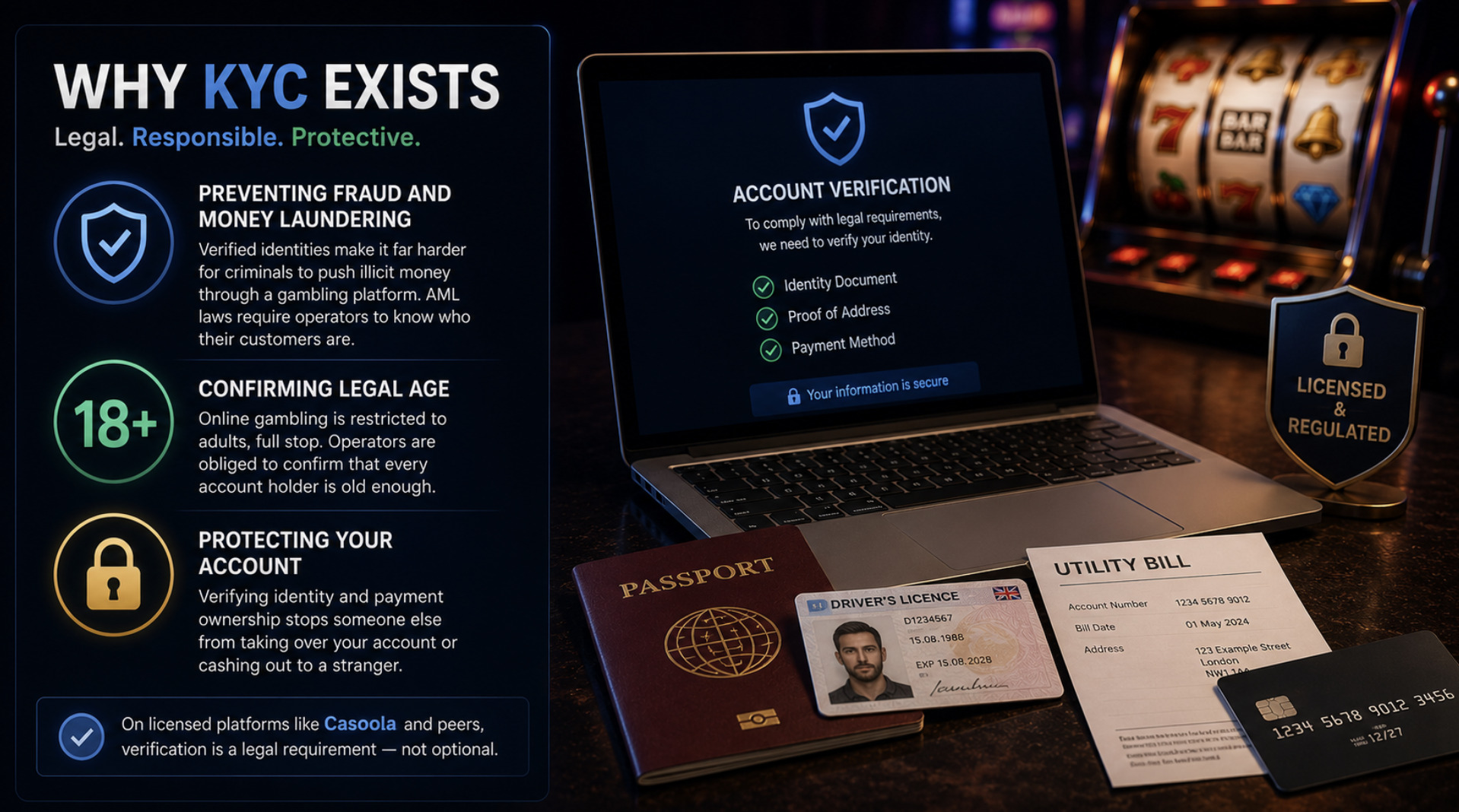
Preventing fraud and money laundering. Verified identities make it far harder for criminals to push illicit money through a gambling platform. Anti-money-laundering law requires operators to know who their customers are, which is the entire origin of the "Know Your Customer" name.
Confirming legal age. Online gambling is restricted to adults, full stop. Operators are obliged to confirm that every account holder is old enough, and a photo ID is how they do it.
Protecting the player's own account. Verifying identity and payment ownership stops someone else from taking over an account or cashing out winnings to a stranger's payment method. In other words, part of KYC exists to protect you.
Regulated operators build these checks into the account lifecycle precisely because their licences require it. On licensed platforms such as Casoola and their peers, verification is a condition of operating within the law rather than an optional extra a site might skip.
Why it so often lands at withdrawal time
The most common complaint about KYC is its timing. Many players breeze through sign-up and depositing, only to be asked for documents the moment they request a payout. It can feel as though the checkpoint was placed deliberately in the way of their money. There is, in fact, a logic to it. To keep sign-up smooth, plenty of operators allow quick registration and deposits, then complete full identity verification before releasing any funds — because the withdrawal is the point at which confirming identity matters most for anti-fraud and anti-money-laundering purposes.
The takeaway for players is refreshingly simple and entirely within your control: verify early. Upload your documents soon after you open the account, long before you have any winnings waiting. Do that, and the checkpoint you would otherwise hit at withdrawal simply is not there anymore. It is the single most effective step for avoiding a slow first payout.
Source-of-funds checks and larger sums
For bigger deposits or substantial wins, an operator may go further and ask about the source of your funds. This means providing evidence — a payslip, a bank statement, or similar — that shows where the money you are gambling with came from. Understandably, this feels more invasive than a simple ID check, and it catches many players off guard. But it is a routine part of anti-money-laundering compliance that applies across the financial industry, not an accusation aimed at you personally. Its purpose is to confirm that significant sums have a legitimate origin. Players who expect this step when dealing with larger amounts, and keep the relevant documents accessible, sail through it with far less friction than those who treat it as a surprise.
How to make verification quick and painless
A few practical habits turn KYC from a multi-day ordeal into a five-minute task:
Submit clear, legible images with all four corners of a document visible and every detail readable. Blurry or cropped photos are the number-one cause of rejection.
Use valid, in-date documents. An expired ID or an out-of-date bill will be bounced.
Make sure your account details match your documents precisely — same spelling of your name, same address, same date of birth.
Verify early, right after signing up, so nothing is holding up a future withdrawal.
Have source-of-funds documents ready if you intend to deal with larger amounts.
Get these right the first time and you avoid the back-and-forth of resubmissions that stretches a quick check into a frustrating week.
What happens to your sensitive documents
It is entirely reasonable to worry about handing your passport and address to a website. This is exactly why the choice of operator matters so much. Regulated operators are legally obliged to protect personal data — to store it securely, use it only for the permitted purposes, keep it only as long as necessary, and restrict who can access it — under both gambling regulation and data-protection law. That dual obligation is the safeguard. It is also the strongest argument for dealing only with licensed, reputable platforms: a regulated casino asking for your ID is following a defined legal process, whereas an unregulated site requesting the same documents is a genuine risk with no accountability behind it. Share your identity documents carefully, and share them only with operators that are regulated.
A sign of a platform doing things right
Reframe KYC and it stops looking like an obstacle. An operator that verifies identity is following the law, blocking fraud, keeping minors out, and protecting your account from takeover — every one of which is something a sensible player should want from the place they trust with their money. Handled the right way, by verifying early and submitting clean documents once, it is a brief, one-time formality that clears the road to smooth, uneventful withdrawals for as long as you use the account.
What KYC looks like for Canadian players
For players in Canada, KYC operates within a wider framework of oversight that makes the whole process more trustworthy. In regulated markets such as Ontario, licensed operators work under standards set by bodies like the AGCO and iGaming Ontario, which include clear expectations around player protection, data handling and anti-money-laundering compliance. This is exactly why the choice between a licensed operator and an unregulated one matters so much when you are handing over identity documents: the licensed operator is accountable to a regulator for how it treats your information, while the unregulated one answers to no one.
In practical terms, a Canadian player should expect to provide a government-issued photo ID such as a passport, driver's licence or provincial ID, a proof of address, and confirmation of their payment method, with the account details matching the documents exactly. Because Canada has a mix of provincial regulatory approaches, the precise experience can vary slightly from one platform to another, but the underlying requirements are consistent everywhere, because they flow from the same anti-money-laundering and age-verification obligations.
If your verification is delayed or rejected
Occasionally a verification does not go through on the first attempt, and knowing why turns a frustrating stall into a quick fix. The most frequent causes are entirely practical: an image that is blurry or has a corner cut off, a document that has expired, an address on a bill that no longer matches the account, or a name spelled differently on the account than on the ID. In almost every case the remedy is simply to resubmit a clear, current document whose details line up precisely with your account.
If a verification is genuinely stuck, contacting the operator's support team directly is the right next step, and it is another reason to favour platforms with responsive, capable support. A regulated operator has a clear process for handling verification queries and a regulator standing behind that process. Patience helps too: submitting good documents once, early, and giving the operator a reasonable window to review them is far more effective than repeatedly uploading rushed, low-quality images that only restart the queue.
Verification and your peace of mind
There is a broader way to think about KYC that reframes the whole experience. The same checks that occasionally slow down a withdrawal are the checks that keep someone else from opening an account in your name, depositing with a stolen card, or cashing out your winnings to their own wallet. In other words, a share of the friction is friction working on your behalf. A platform that verifies rigorously is a platform where an impostor cannot easily impersonate you, and where the money in your account is genuinely protected as yours.
Seen in that light, the ideal approach is proactive rather than reluctant. Complete your verification the day you sign up, while there is no winnings clock ticking and no pressure. Keep a clear photo of your ID and a recent proof of address to hand, so that if a source-of-funds request ever arrives, you can answer it in minutes rather than scrambling. And treat the request for documents not as a sign that something is wrong, but as confirmation that the operator is doing its job. Handled this way, KYC becomes a one-time formality you barely remember — and a quiet guarantee that your account, and your money, stay firmly under your control.
Frequently asked questions
Why does an online casino need my ID? To meet legal requirements: preventing fraud and money laundering, confirming you are of legal age, and protecting your account. It is standard for any regulated business that handles money.
Why am I only asked to verify when I try to withdraw? Many operators allow quick sign-up and deposits, then complete full verification before paying out, since that is when it matters most. Verifying early removes the delay entirely.
Is it safe to send my documents to a casino? With a licensed, regulated operator bound by data-protection law, documents are stored and handled securely. Verify only with regulated platforms, and avoid unregulated ones.
Why is a casino asking where my money came from? For larger amounts, anti-money-laundering rules can require operators to confirm a legitimate source of funds. It is a routine compliance step, not an accusation.
How long should verification take? Usually minutes to a day or two when documents are clear and match your account. Delays almost always come from blurry images, expired documents or mismatched details.