: Inter Is Everywhere and There Are Good Reasons for That
The Problem Inter Was Built to Solve
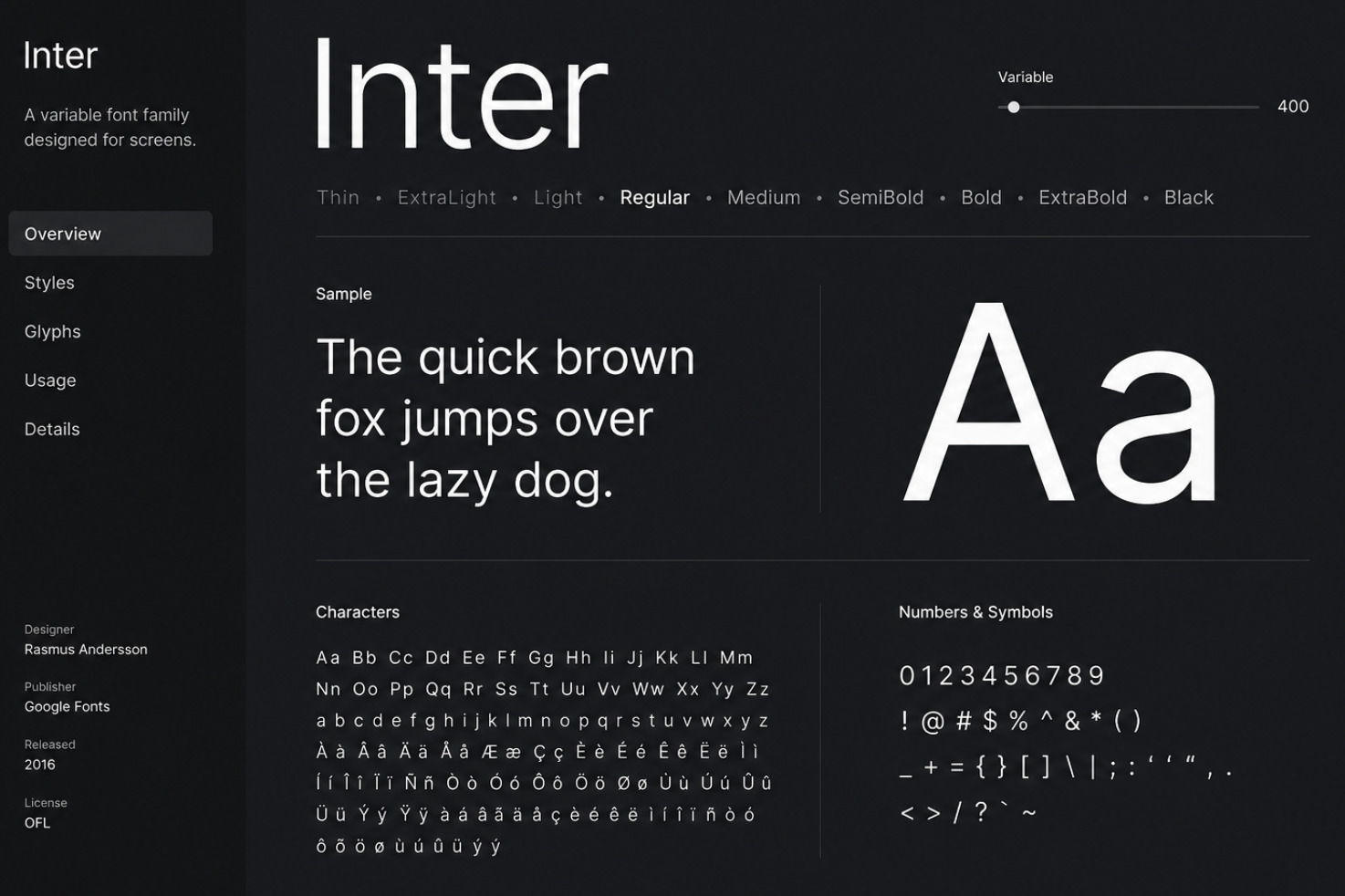
Rasmus Andersson began working on what would become Inter in 2016, during his time at Figma. The design team had spent a month searching for a typeface that performed better than Roboto at small sizes — the kind of sizes that dominate interface typography, where labels, captions, and data values need to be legible at twelve or fourteen pixels. Roboto came out on top of the search, which was unsatisfying because Roboto's limitations were the reason for the search in the first place.
Roboto was originally designed to serve as both a display typeface and a text typeface. That dual mandate introduced compromises. The apertures — the openings in characters like 'c', 'e', and 's' — were tighter than ideal for small sizes. At a glance, at low resolution, similar letterforms blurred together.
Andersson built Inter with a single mandate: make screen text as legible as possible. Every design decision followed from that constraint.
What Inter Does Differently
The x-height. Inter has a tall x-height — approximately 65% of cap height, compared to Times New Roman at around 45%. A tall x-height increases the optical size of lowercase letters without increasing the actual font size. At 16 pixels on a mobile screen, Inter's lowercase letters occupy more pixels than a typeface with a shorter x-height, making them easier to resolve at a glance. This is not an aesthetic preference. It is a legibility decision with measurable consequences.
The apertures. Helvetica, which dominated graphic design for decades, closes its apertures tightly. This gives it a rational, geometric appearance at display sizes and makes it difficult to read at body text sizes on screens where the apertures close further. Inter opens its apertures wide — the 'c', the 'e', the 'a', the 's' all have generous openings. Similar letterforms stay distinct at small sizes.
The variable font architecture. Inter is a variable font with a weight axis (Thin at 100 to Black at 900) and an optical size axis. The opsz axis allows the same font file to adapt its design for different contexts: at display sizes, it tightens spacing and refines details; at text sizes, it loosens spacing and increases apertures. This is the same principle that makes SF Pro work, implemented in an open-source typeface that anyone can use anywhere.
OpenType features. Inter includes tabular figures (numbers that occupy the same width, essential for data tables and financial interfaces), contextual alternates, ligatures, and fractions. These features allow Inter to function in contexts — data dashboards, code documentation, financial interfaces — where a less thorough typeface would require compromises or workarounds.
The Open Source Dimension
Inter is released under the SIL Open Font License. It can be used in commercial projects, modified, and redistributed freely. Andersson has been transparent about the economics of the project — it was funded primarily through GitHub Sponsors and community contributions, making it one of the prominent examples of sustainable open-source type design.
This is directly relevant to the Fontmatrix community. Inter installs without complications on any Linux distribution that has access to Google Fonts or to the project's GitHub repository. It renders correctly through fontconfig. It performs well at every size that matters for interface and documentation typography. The license imposes no restrictions on how it is used.
Figma uses Inter as its system typeface — which created a feedback loop. As Figma became the dominant UI design tool, Inter became the default starting font for interface mockups. Designers built mockups in Inter, handed them to developers, and the developers implemented in Inter. The font became the path of least resistance, which is both the mechanism of its success and the limit of its appeal.
The Problem With Being Everywhere
By 2026, Inter's ubiquity is also becoming its limitation. When every SaaS landing page, startup pitch deck, and developer documentation site uses Inter, the font becomes invisible in a way that is distinct from the invisibility that good typography aims for. Properly invisible typography is typography that does not interrupt reading. Inter has become invisible in a different sense — it signals "template," the visual equivalent of recognising a framework without reading the content.
Designers who understand this are making deliberate choices. They either use Inter intentionally, acknowledging its neutrality as a feature — similar to how architects use exposed concrete — or they reach for alternatives: Söhne for premium positioning, Neue Montreal for contemporary distinction, or any of the growing number of high-quality screen sans-serifs that Inter's success helped normalise.
For Linux users managing font libraries in Fontmatrix: Inter is worth having. Install it, tag it, understand what it does and what it costs. The cost is not financial. It is the cost of looking like everyone else — which is either irrelevant or significant depending entirely on what you are building.